Key Takeaways:
- Method Selection Drives Program Success: Choosing appropriate NDT techniques affects inspection reliability, production throughput, and regulatory compliance across aerospace supply chains.
- Material and Geometry Define Capability: Component characteristics determine which testing methods can effectively detect relevant defect types without compromising schedule or quality.
- Regulatory Standards Are Non-Negotiable: AS9100, Nadcap, and OEM specifications establish mandatory NDT requirements that influence supplier qualification and audit readiness.
How can engineers verify the integrity of critical components without cutting them open or damaging the material? Selecting the right nondestructive testing (NDT) method is a key challenge in industries where safety, reliability, and regulatory compliance are non-negotiable.
Valence Surface Technologies operates as one of the largest independent aerospace surface finishing and inspection providers, supporting complex aerospace programs with advanced NDT capabilities and rigorous quality standards.
In this piece, the discussion will cover the top considerations for selecting nondestructive testing methods, including material type, defect detection needs, inspection standards, and operational requirements.
What Is Nondestructive Testing And Why It Matters In Aerospace
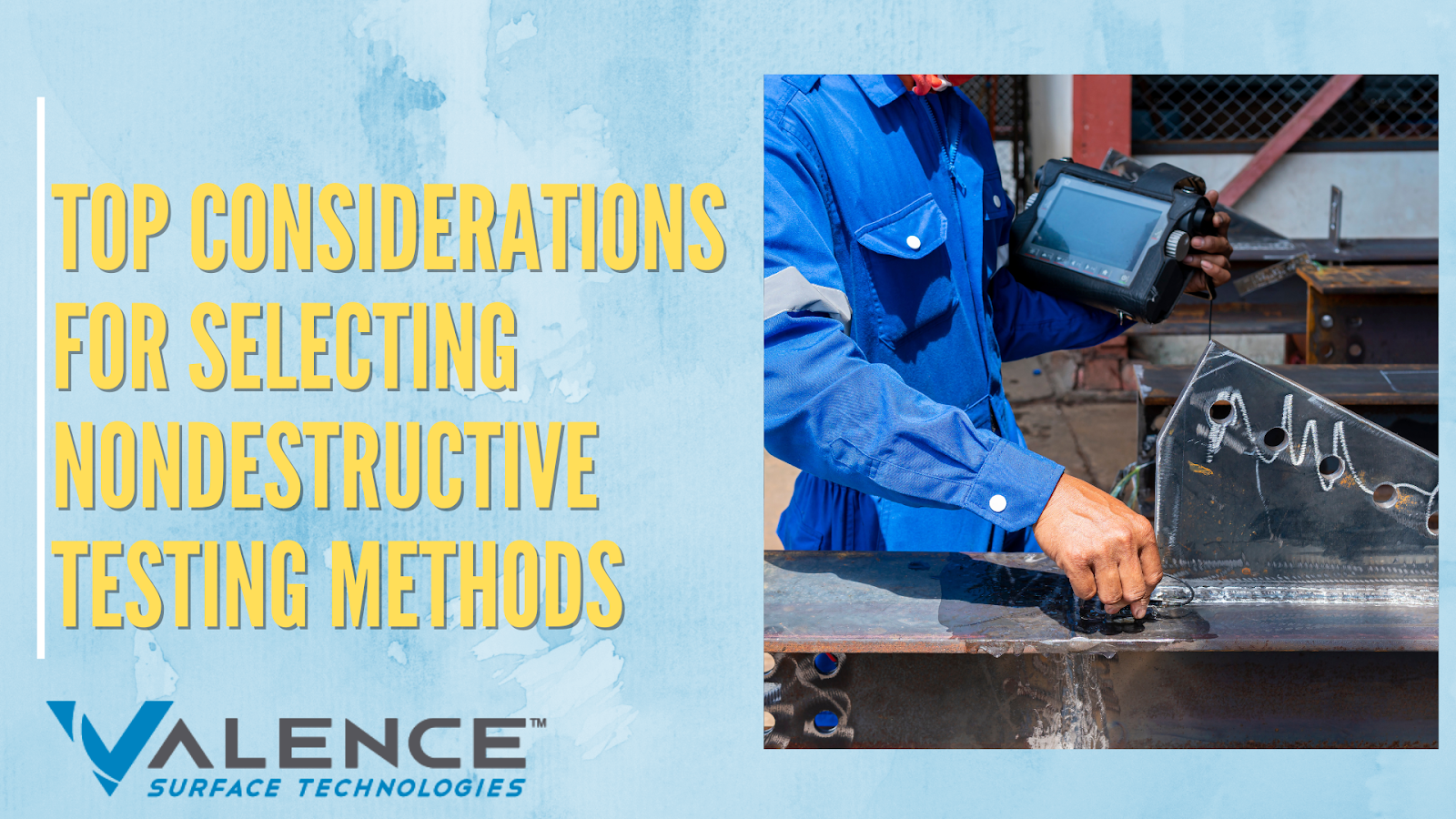
Nondestructive testing (NDT) examines materials and components for defects without damaging them. Unlike destructive testing, which breaks or cuts samples, NDT allows parts to remain usable while confirming they meet structural, material, and dimensional standards.
Why Aerospace Manufacturing Uses NDT
Aerospace components face extreme stress, temperature, vibration, and corrosion. NDT verifies that parts can perform reliably by detecting manufacturing defects, material inconsistencies, and processing issues before they enter service.
The Risk of Missed Defects
Undetected flaws can grow over time, leading to failures, safety risks, and costly program delays. Consequences may include warranty claims, fleet inspections, operational restrictions, and reputational damage.
Strengthening Supply Chains
NDT helps ensure consistent quality across suppliers and production runs. It provides documented proof of compliance for audits and customer acceptance, supporting reliable manufacturing and reducing supply chain disruptions.
Valence Surface Technologies operates under a unified Quality Management System that delivers consistent NDT capabilities across strategically located facilities. Our comprehensive approvals and certifications support mission-critical parts for commercial aerospace, defense, and space programs.
Key Factors That Influence The Selection Of Nondestructive Testing Methods
Multiple variables shape NDT method selection. Understanding these factors ensures your testing approach aligns with technical requirements, regulatory standards, and operational constraints.
Defect Type and Location
Different NDT methods excel at detecting specific discontinuities. Surface-breaking cracks, subsurface voids, material thinning, and inclusion detection each require tailored approaches. The depth and orientation of expected defects determine which testing techniques can provide adequate sensitivity.
At Valence, our regional inspection facilities support aerospace manufacturers across the country, including our specialized operations for non destructive testing california, where our team performs advanced inspections on critical flight components.
Inspection Sensitivity Requirements
Customer specifications and regulatory standards define minimum detectable flaw sizes. Critical flight hardware often requires higher sensitivity than non-critical components, influencing method selection and calibration standards.
Production Volume and Throughput Needs
High-volume manufacturing environments require testing methods that balance thoroughness with cycle time. Automated NDT systems may justify capital investment for large production runs, while manual techniques remain cost-effective for low-volume or prototype work.
Accessibility and Part Handling
Component geometry affects inspector access to critical surfaces. Complex internal passages, tight radii, or limited line-of-sight conditions may eliminate certain NDT methods. Part size and weight influence handling requirements and equipment selection.
Cost and Resource Availability
Method selection must account for equipment investment, consumable costs, technician certification requirements, and facility infrastructure. Some techniques require specialized environments, darkened rooms for fluorescent penetrant inspection or radiation-shielded areas for radiography.
At Valence, our integrated facilities help customers streamline inspection workflows, including our capabilities for non destructive testing houston, where we support major aerospace and energy manufacturing programs.
Documentation and Traceability Requirements
Aerospace programs demand objective evidence of inspection results. Methods that produce permanent records, radiographic film, digital images, or automated data files, may be preferred over techniques requiring technician interpretation without physical documentation.
Comparing Common Nondestructive Testing Methods Used In Aerospace
Each NDT technique offers distinct capabilities and limitations. Understanding these differences enables informed method selection aligned with part requirements.
Visual Inspection
Visual testing uses direct observation or optical aids to identify surface discontinuities, dimensional variations, and finish quality. It serves as the first line of defense but cannot detect subsurface defects. Borescopes and video probes extend visual access to internal features.
Liquid Penetrant Testing
Penetrant inspection detects surface-breaking discontinuities in nonporous materials. Capillary action draws penetrant into defects, which become visible under proper lighting after developer application. This method works on nonporous materials but requires surface preparation and cannot detect subsurface flaws.
Magnetic Particle Inspection
Magnetic particle testing identifies surface and near-surface discontinuities in ferromagnetic materials. A magnetic field applied to the part causes ferrous particles to accumulate at defect sites. This technique offers high sensitivity for cracks but only works on materials that can be magnetized.
Eddy Current Testing
Eddy current inspection uses electromagnetic induction to detect surface and near-surface defects, measure coating thickness, and verify material properties. It works well on conductive materials and provides fast, automated inspection capability. Depth penetration is limited compared to ultrasonic methods.
Ultrasonic Testing
Ultrasonic inspection uses high-frequency sound waves to detect internal discontinuities, measure wall thickness, and characterize material properties. It provides excellent depth penetration and sensitivity but requires skilled technicians and may struggle with complex geometries or highly attenuating materials.
Radiographic Testing
Radiography uses X-rays or gamma rays to create images revealing internal structure and discontinuities. It produces permanent records and detects volumetric defects effectively. However, it requires radiation safety controls, longer inspection times, and may miss planar defects poorly oriented to the radiation beam.

How Material Type And Component Geometry Affect NDT Selection
Physical characteristics of parts and materials directly constrain applicable testing methods. Evaluating these factors early in the selection process prevents mismatches between inspection requirements and technical capability.
Material Conductivity and Magnetic Properties
Conductive materials enable eddy current testing, while ferromagnetic materials allow magnetic particle inspection. Non-conductive composites require different approaches, often ultrasonic or radiographic techniques. Material properties determine which physical principles can be applied effectively.
Surface Condition and Finish Requirements
Some NDT methods require specific surface preparations. Penetrant testing needs clean, dry surfaces free from coatings that could seal defects. Magnetic particle inspection may require coating removal. Surface roughness affects ultrasonic coupling and eddy current sensitivity. Post-inspection cleaning requirements must align with subsequent processing steps.
Component Size and Thickness
Part dimensions influence equipment selection and inspection approach. Thick sections may require higher-energy radiation sources or lower-frequency ultrasonic testing. Very thin materials limit options for subsurface inspection. Large components may exceed standard equipment capacity, requiring specialized handling.
Geometry Complexity
Internal cavities, tight radii, and complex contours challenge inspector access and sensor placement. Some geometries prevent effective sound wave transmission or magnetic field establishment. Advanced techniques like phased array ultrasonics or computed tomography may be necessary for intricate parts, increasing inspection costs and cycle time.
Temperature and Environmental Considerations
Some NDT methods require controlled environments. Penetrant inspection typically occurs at room temperature. Thermographic testing depends on temperature differentials. Environmental factors, humidity, contamination, ambient light, affect method reliability and must be managed during inspection operations. At Valence, we maintain strict environmental control standards across all locations, including our facility dedicated to non destructive testing florida.
Compliance, Certification, And Quality Standards In Nondestructive Testing
Aerospace manufacturing operates under stringent regulatory frameworks that mandate specific NDT requirements. Compliance drives method selection and influences supplier qualification decisions.
Regulatory Agency Requirements
Aviation authorities and defense programs define NDT standards through approved design data, OEM specifications, and program requirements. These rules specify acceptable inspection methods, sensitivity levels, technician qualifications, and documentation practices. Non-compliance can delay certifications or trigger corrective actions.
AS9100 Quality Management Integration
AS9100 standards require controlled procedures, traceable measurements, and calibrated inspection equipment. NDT methods must support traceability and audit readiness across facilities. At Valence, we often integrate inspection with additional manufacturing processes to streamline production, including services available at our industrial metal finishing houston location.
Nadcap Accreditation
Nadcap audits verify compliance for special processes such as NDT. Selected methods must demonstrate technical capability, approved procedures, and properly qualified personnel.
OEM-Specific Requirements
Aircraft manufacturers and prime contractors often impose additional NDT requirements beyond industry standards. Understanding these specifications early helps avoid costly changes later. Our nationwide footprint helps customers stay compliant across supply chains, including facilities performing non destructive testing georgia.
Personnel Certification Standards
NDT technicians must meet certification requirements such as SNT-TC-1A or NAS-410. More advanced inspection methods often require higher training and qualification levels.
Documentation and Record Retention
Aerospace programs require long-term records of inspection results, equipment calibration, and technician certification. Methods that produce clear documentation are often preferred.
Final Thoughts
The top considerations for selecting nondestructive testing methods encompass technical capability, regulatory compliance, operational efficiency, and program risk management. Effective selection requires balancing inspection sensitivity against production throughput, material constraints against geometry complexity, and cost considerations against quality requirements.
For aerospace manufacturers, NDT method selection represents a strategic decision that affects supply chain performance, customer acceptance, and competitive positioning. The right approach supports program continuity while maintaining the uncompromising quality standards that mission-critical applications demand.
Working with an integrated surface finishing partner that maintains comprehensive NDT capabilities across multiple facilities reduces supplier fragmentation and ensures consistent inspection standards. This operational model supports audit readiness, accelerates production ramp-ups, and provides the technical depth needed for complex aerospace programs.
Frequently Asked Questions About Top Considerations For Selecting Nondestructive Testing Methods
What are the primary nondestructive testing methods used in aerospace manufacturing?
Visual inspection, liquid penetrant testing, magnetic particle inspection, eddy current testing, ultrasonic testing, and radiographic testing represent the core NDT methods for aerospace applications. Method selection depends on material type, defect location, and sensitivity requirements.
How do regulatory standards like AS9100 influence nondestructive testing method selection?
AS9100 requires controlled documented information, qualified personnel, and calibrated equipment for NDT operations. Method selection must support traceability, audit readiness, and customer-specific requirements while maintaining compliance with industry standards and regulatory mandates.
What factors should I consider when evaluating NDT methods for my specific part geometry and material composition?
Assess material conductivity and magnetic properties, surface condition requirements, component thickness and size, geometry complexity, and accessibility constraints. These physical characteristics determine which testing methods can effectively detect relevant defects within your operational parameters.
How do I determine whether I need surface defect detection, subsurface detection, or both?
Evaluate failure modes, stress concentrations, and service conditions for your components. Critical flight hardware typically requires both surface and subsurface inspection. Customer specifications and regulatory standards often mandate specific inspection types based on part classification and application.
How should I balance testing speed and accuracy when selecting an NDT method for high-volume production?
Automated inspection systems maximize throughput while maintaining sensitivity for high-volume operations. Evaluate cycle time requirements against defect detection capability. Consider whether capital investment in advanced equipment justifies production velocity gains for your volume levels.
How can I ensure consistent nondestructive testing results across multiple production runs and supplier facilities?
Implement standardized procedures, maintain equipment calibration programs, and require personnel certification to recognized standards. Work with integrated surface finishing partners operating under unified quality management systems that deliver consistent NDT capabilities across all locations.