
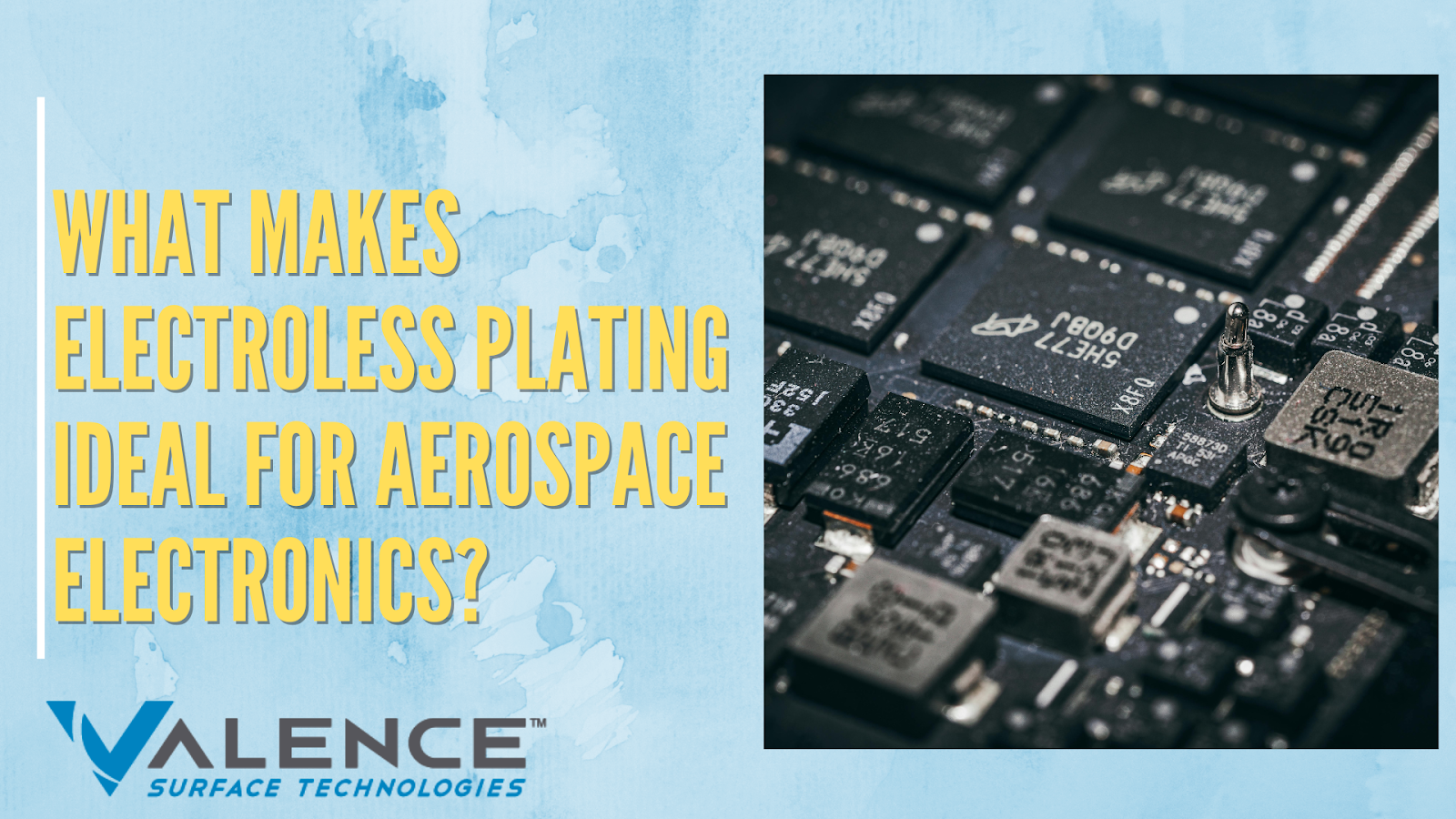
Key Takeaways:
- Electroless plating provides uniform coatings for complex aerospace electronics: The autocatalytic process ensures consistent thickness on intricate components, preventing weak points that could lead to corrosion or failure.
- Nickel-based electroless coatings improve durability and corrosion resistance: Electroless nickel-phosphorus and nickel-boron finishes protect aerospace electronics from vibration, heat, and harsh environmental exposure.
- Compliance with aerospace standards ensures long-term reliability: Electroless plating processes that meet AMS, ASTM, and NADCAP requirements help aerospace manufacturers maintain quality, safety, and performance over decades of operation.
What keeps delicate aerospace electronics functioning reliably in environments filled with extreme heat, vibration, and corrosive conditions? In many cases, the answer lies in surface-finishing methods that act as armor for sensitive components. Electroless plating has become a critical solution for this challenge, providing consistent metal coatings even on complex parts.
As the world’s largest independent aerospace surface finishing provider with thousands of industry approvals and decades of combined expertise, Valence Surface Technologies brings deep technical insight into advanced plating processes used in aerospace applications.
In this piece, readers will learn what electroless plating is, why it’s ideal for aerospace electronics, and how it enhances durability, conductivity, and corrosion resistance.
How Electroless Plating Works In Aerospace Electronic Components
The electroless plating process begins when aerospace electronic components are placed in a controlled chemical bath containing metal ions and reducing agents. Unlike electroplating, which requires an external current and conductive materials, electroless plating uses an autocatalytic chemical reaction that deposits metal directly onto the component surface.
Surface Preparation and Activation
Before plating, components undergo thorough cleaning and activation. Alkaline cleaners remove oils and contaminants, while acid etching creates microscopic roughness for stronger adhesion. Catalytic materials such as palladium are then applied to non-conductive surfaces to initiate the plating reaction. Proper preparation ensures strong coating adhesion and long-term reliability.
The Autocatalytic Deposition Mechanism
When metal ions contact the activated surface, they are chemically reduced, forming a metallic layer that continues to catalyze further deposition. This self-sustaining reaction coats all exposed surfaces evenly, regardless of geometry or conductivity. Bath chemistry, temperature, and pH control the deposition rate and coating properties.
Achieving Controlled Thickness and Properties
Coating thickness is controlled by immersion time, allowing precise finishes for electronic components. The bath chemistry also determines phosphorus content, which influences hardness, magnetism, solderability, and corrosion resistance.
Low-phosphorus coatings (2–5%) maximize hardness, medium-phosphorus coatings (6–9%) balance performance, and high-phosphorus coatings (10–13%) provide superior corrosion protection and non-magnetic properties for complex aerospace assemblies.
Valence provides the technical depth and NADCAP-certified capacity required to eliminate supply chain risk for mission-critical aerospace electronics. Contact the team today to discuss your project requirements.
Key Performance Benefits Of Electroless Plating For Aerospace Electronics
Electroless plating delivers measurable performance advantages that directly address the reliability requirements and production constraints of the aerospace industry. At Valence Surface Technologies, we support aerospace manufacturers through a nationwide network of finishing facilities, including operations specializing in electroless nickel plating houston, where we provide precision coatings for mission-critical components.
Uniform Coating Distribution on Complex Geometries
The autocatalytic nature of electroless plating provides significantly more uniform thickness on complex geometries than electrolytic plating, which is limited by current distribution and “edge effects.” Internal cavities, threaded holes, and sharp edges receive consistent coverage, preventing the thin spots that often become corrosion initiation sites.
Superior Corrosion and Wear Resistance
Electroless nickel-phosphorus coatings form dense, amorphous structures with minimal grain boundaries, blocking corrosive attacks. High-phosphorus deposits achieve exceptional salt-spray performance, while the coating’s inherent hardness, which can be increased to approximately 1,000 HV through heat treatment, protects against fretting wear caused by constant flight vibration.
Dimensional Precision and Tolerance Control
Because the coating adds thickness predictably and uniformly, it enables the precise dimensional control required for connector pins and sensor housings. This predictability often eliminates the need for post-plating machining, reducing production costs while maintaining strict geometric tolerances.
Electrical and Thermal Properties
These deposits offer controlled electrical conductivity, ideal for EMI/RFI shielding, while maintaining the high solderability needed for PCB assembly. Additionally, the finish’s thermal conductivity facilitates critical heat dissipation for power electronics and high-frequency components in confined avionics bays.
Materials Commonly Used In Electroless Plating For Aerospace Electronics
Aerospace electronics finishing relies on specific electroless plating chemistries selected for their performance characteristics and regulatory compliance.
Electroless Nickel-Phosphorus (ENi-P)
ENi-P is the most commonly specified electroless plating for aerospace electronics. Medium-phosphorus coatings (6–9% P) balance hardness, corrosion resistance, and solderability. They are widely used for avionics housings, connector bodies, and electronics enclosures, meeting AMS 2404 standards and providing strong corrosion protection.
At our Florida facility offering electroless nickel plating orlando fl, we apply these coatings under tightly controlled process conditions to support aerospace OEM and defense requirements.
Electroless Nickel-Boron (ENi-B)
ENi-B coatings are suited for high-temperature aerospace electronics where ENi-P may degrade. With hardness above 700 HV, they protect engine-mounted sensors and hot-section electronics while maintaining stability during extreme thermal cycling.
Electroless Gold and Palladium
Precious metal coatings provide highly reliable electrical contact surfaces. Electroless gold over nickel (ENIG) improves solderability and prevents copper oxidation in PCBs, while electroless palladium offers a cost-effective option for high-cycle contact applications.
Composite and Specialty Formulations
Specialized coatings address unique aerospace challenges. Nickel-PTFE composites reduce friction for moving contacts, while nickel-diamond composites provide extreme wear resistance for components exposed to abrasive conditions. Our Midwest operations, including facilities providing electroless nickel plating michigan, support these advanced processes for aerospace and defense manufacturers across the region.

Reliability And Durability Requirements For Aerospace Electronic Finishes
Aerospace electronics finishing must satisfy quantified reliability requirements that exceed commercial electronics standards by orders of magnitude.
Environmental Exposure Resistance
Aerospace electronics are exposed to extreme temperatures from -65°F to 350°F, requiring coatings that maintain adhesion, corrosion protection, and electrical performance across repeated thermal cycles. Testing, such as ASTM B117 salt fog and high-humidity exposure, verifies durability in harsh maritime and tropical environments.
Mechanical Durability Standards
Continuous vibration from engines and flight forces places heavy stress on electronic assemblies. Adhesion and hardness requirements ensure coatings resist wear, connector mating cycles, and sliding contact. Thermal shock testing confirms coatings remain intact during rapid temperature changes.
Long-Term Performance Validation
With commercial aircraft lasting up to 30 years and military platforms over 40, coatings must prove long-term reliability. Accelerated life testing and real-world fleet data help validate performance and guide ongoing specification improvements.
At Valence, our network of finishing facilities, including those specializing in electroless nickel plating illinois, supports aerospace programs through validated processes and decades of operational expertise.
Failure Mode Prevention
Aerospace finishing standards address known failure risks. Limits on coating porosity prevent corrosion, controlled phosphorus levels reduce cracking, and thickness requirements balance protection with stable electrical contact performance.
Industry Standards And Compliance For Electroless Plating In Aerospace Electronics
Regulatory compliance defines the acceptability of aerospace electronics finishing and determines supplier qualification status.
AMS and ASTM Specifications
AMS 2404 governs the requirements for electroless nickel plating in aerospace applications, specifying composition limits, thickness requirements, adhesion criteria, and testing protocols. ASTM B733 provides the standard specification for autocatalytic (electroless) nickel-phosphorus coatings and classification systems. Compliance requires documented process controls, qualified operators, and accredited laboratory testing capabilities.
NADCAP Accreditation Requirements
The National Aerospace and Defense Contractors Accreditation Program (NADCAP) establishes audit criteria for chemical processing, including electroless plating. Accreditation requires demonstrated process control, equipment calibration, operator training documentation, and statistical process monitoring. Suppliers maintaining NADCAP accreditation undergo periodic audits verifying continued compliance and process capability.
Customer-Specific Process Approvals
Major aerospace OEMs maintain approved processor lists requiring demonstrated capability beyond baseline specifications. Approval processes include facility audits, process validation testing, first article inspections, and ongoing performance monitoring. Our Gulf Coast operations, including our site for electroless nickel plating louisiana, help support these programs with regionally accessible finishing capacity.
Quality Management System Integration
AS9100D quality management system requirements ensure that electroless plating operations integrate with broader manufacturing quality systems. Documentation controls, nonconforming material procedures, corrective action processes, and continuous improvement activities demonstrate the organizational maturity required for participation in the aerospace supply chain.
Final Thoughts
Electroless plating addresses the fundamental challenge in aerospace electronics finishing: delivering uniform, reliable protection across geometrically complex components operating in demanding environments. The autocatalytic deposition mechanism provides coating consistency that is impossible with current-driven processes while meeting stringent aerospace specifications for corrosion resistance, wear protection, and long-term durability.
Mission-critical applications require finishing partners who understand that surface treatment directly impacts system reliability. Valence combines technical mastery, production capacity, and regulatory compliance to support aerospace electronics manufacturers from prototype through full-rate production.
Frequently Asked Questions About What Makes Electroless Plating Ideal For Aerospace Electronics?
How does electroless plating differ from traditional electroplating methods?
Electroless plating uses chemical reduction without external current, enabling more uniform coating thickness across complex geometries regardless of part shape or electrical conductivity. Traditional electroplating requires an electrical current and produces thickness variations that depend on geometry and current distribution.
Why is coating uniformity critical in aerospace electronics manufacturing?
Coating thin spots becomes corrosion initiation points and premature failure sites in harsh aerospace environments. Uniform thickness ensures consistent protection across all surfaces, extending component service life and maintaining electrical performance throughout demanding operational conditions.
What aerospace certifications and standards does electroless plating need to meet?
Aerospace electroless plating must comply with AMS 2404 and ASTM B733 specifications. Suppliers require AS9100D quality management certification, NADCAP accreditation for chemical processing, and customer-specific process approvals for major aerospace programs.
Can electroless plating reduce production costs while maintaining quality standards?
Electroless plating reduces costs by enabling uniform deposition that minimizes post-plating machining, eliminates fixturing required for current distribution, and reduces rejection rates due to coating defects. The process maintains aerospace quality standards while improving dimensional control and throughput.
How does electroless plating extend the lifespan of aerospace electronic components?
The dense, amorphous coating structure provides superior corrosion resistance and wear protection compared to alternative finishes. High-phosphorus electroless nickel, when applied to appropriate thicknesses, can achieve very high salt-spray performance, and heat-treated coatings can reach hardness values approaching 1,000 HV, protecting components for a long time.
What environmental and safety advantages does electroless plating offer over traditional finishing methods?
Electroless plating eliminates hexavalent chromium and other toxic materials used in chromate conversion coatings. The process operates at lower temperatures than many alternatives, reducing energy consumption. Closed-loop chemistry management minimizes waste generation while maintaining process performance.